
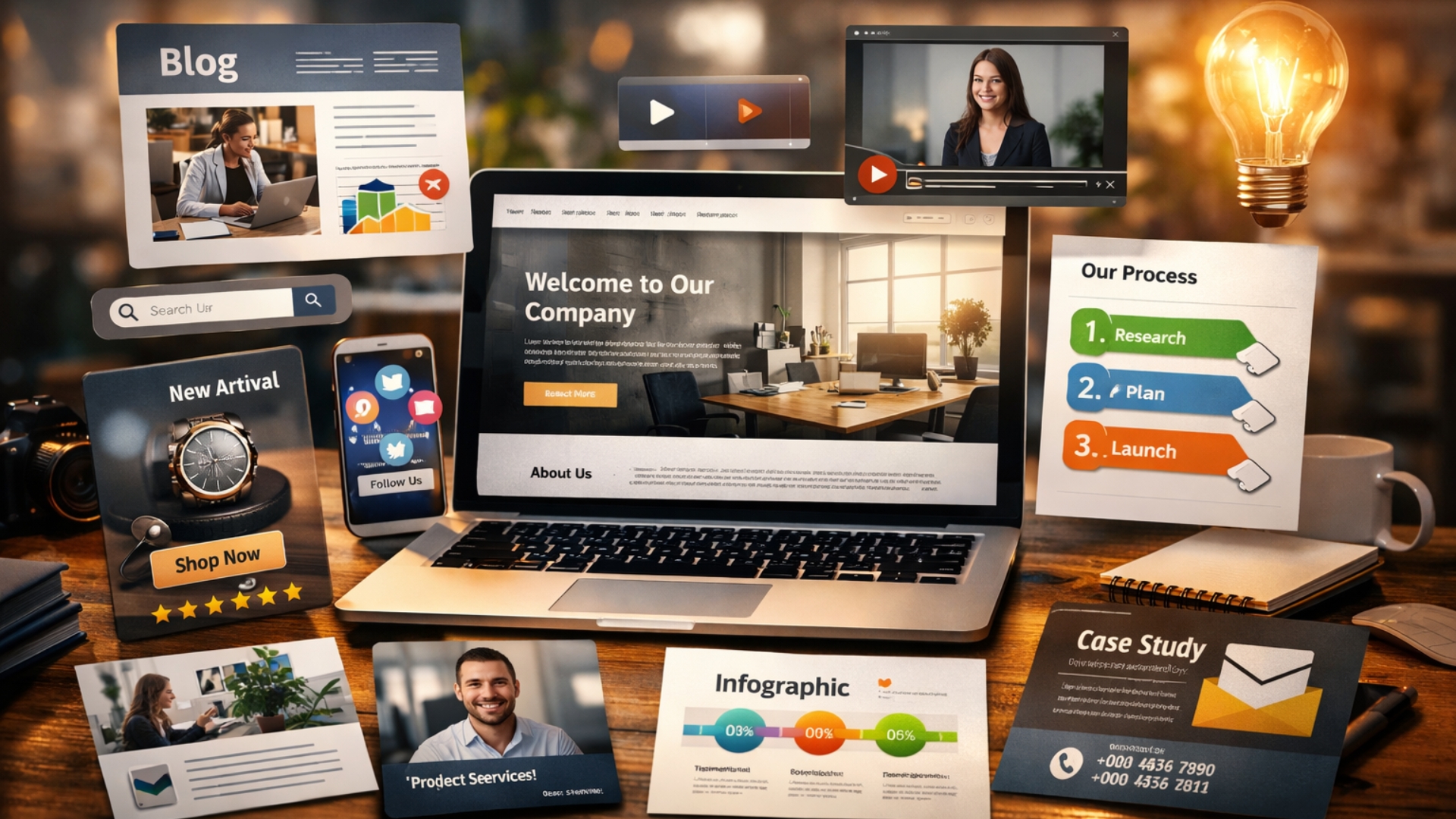
Business websites with active blogs generate 97% more leads than those without one. Yet most businesses still treat their website as a digital brochure instead of a content engine. The types of content on your website directly influence your SERP rankings, E-E-A-T signals, and conversion rates. A single homepage is not a content strategy. Search engines and buyers both need layered, structured content to assess authority and trust. Understanding which content types a business website needs is the foundation of any effective content marketing strategy. This article covers the ten essential content types your site must have in 2026.
Key Takeaways
- Business websites with active blogs generate 97% more leads than those without.
- Case studies and testimonials are the highest-converting trust signals on any website.
- Service or product pages must balance SEO requirements with conversion-focused copy.
- An FAQ page improves topical authority and boosts Answer Engine Optimisation performance.
10 Types of Content Every Business Website Needs in 2026
1. Blog Posts
Blog posts are the most effective content type for building organic search visibility. Companies that publish 9 or more posts monthly achieve 35.8% year-over-year traffic growth versus just 16.5% for those blogging one to four times. Each post targets a specific keyword and expands your site’s topical authority. High-quality long-form content also earns 77.2% more backlinks than short articles, according to research by Ahrefs. Treat your blog as a compounding asset, not a publishing afterthought.
2. Service or Product Pages
Service and product pages sit at the bottom of the conversion funnel. These pages must communicate your offer clearly and answer buyer objections. Product pages optimised with technical specifications receive 43% more organic traffic than non-optimised equivalents. Each service should have its own dedicated page with a target keyword, structured H2 and H3 headings, schema markup, and a prominent call to action. Bundling multiple services onto one page dilutes both SEO relevance and user intent alignment.
3. Case Studies
Case studies are among the most powerful bottom-of-funnel content assets a business can publish. They convert well because they demonstrate measurable outcomes for real clients. According to Neil Patel, testing case studies on a website increased sales by 185% in documented experiments. A strong case study follows a problem-solution-result structure with specific metrics. Include client quotes, data points, and before-and-after comparisons for maximum credibility and persuasion.
4. Testimonials and Social Proof
Testimonials are short, result-focused endorsements from satisfied clients. They function as social proof signals at every stage of the buyer journey. 98% of consumers read online reviews before making a purchase, and testimonials on landing pages directly influence conversion rates. Place them near calls to action, on service pages, and on the homepage. Video testimonials outperform text-only versions in credibility. Keep each testimonial specific, naming the outcome achieved rather than offering vague praise.
5. Landing Pages
Landing pages are campaign-specific pages designed to convert a single type of visitor. They isolate a specific offer and remove distractions from the conversion path. Well-optimised landing pages aligned with search intent can drive significant uplift. Campaign Monitor achieved a 31.4% increase in conversions simply by matching landing page copy to the verb used in a visitor’s search query. Each paid campaign, lead magnet, or product launch should have its own dedicated landing page to maximise return on ad spend.
6. About Page
The About page is one of the most visited pages on any business website. It directly supports E-E-A-T signals, which Google uses to assess content quality and author credibility. A weak About page communicates low trust to both users and search engines. Include your founding story, core team, credentials, industry awards, and mission statement. Structured content also helps Google’s Knowledge Graph associate your brand with your area of expertise. Treat this page as a trust asset, not a formality.
7. FAQ Page
FAQ pages serve dual purposes: they reduce pre-sale friction and improve Answer Engine Optimisation performance. Google AI Overviews now appear for over 13% of all US desktop queries, pulling answers from structured content. FAQ pages written in natural, conversational language are frequently cited in AI Overview responses. Use FAQ schema markup to improve eligibility for rich results. Each question should mirror exactly how your target audience types or speaks a query into a search engine.
8. Long-Form Guides and Pillar Pages
Pillar pages are cornerstone content pieces that cover a broad topic in depth. They anchor your internal linking structure and establish topical authority across a subject cluster. Long-form content earns 77.2% more backlinks on average than short articles, making pillar pages high-leverage investments. A well-built pillar page targets a head keyword and links to cluster posts covering related subtopics. This structure signals to Google that your site has comprehensive expertise in a given subject.
9. Original Research and Data-Driven Content
Original research is a high-authority content type that attracts backlinks at scale. Sites publishing original research see an average 42.2% increase in backlinks earned over time. Surveys, industry reports, proprietary data analysis, and benchmark studies qualify as original research. This content type establishes thought leadership and generates press citations. Even a simple survey of 200 customers can produce unique data that other publishers reference, building domain authority without active outreach.
10. Video Content and Multimedia
Video is the highest-ROI media format in content marketing, ahead of images and blog posts. 91% of people have watched an explainer video to learn about a product or service, and 86% of video marketers say video increases organic traffic. Embed videos on service pages, blog posts, and landing pages to increase dwell time and reduce bounce rate. Explainer videos, client testimonials, product walkthroughs, and founder interviews all serve different funnel stages. Treat video as a complement to written content, not a replacement.
The Bottom Line
A business website that lacks these ten content types is leaving leads, rankings, and revenue on the table. Blog posts build organic traffic. Service pages convert visitors. Case studies and testimonials build trust. FAQ pages and pillar content capture AI Overview citations. Original research earns backlinks. Video increases engagement across every page it appears on. Each content type serves a distinct role in your content marketing strategy and the buyer’s journey. At TheLikharis, we create every content type with precision, an SEO strategy, and your audience’s intent in mind. Audit your site today and identify the gaps. Then build a content plan that turns your website into your best-performing sales asset.

Frequently Asked Questions
What types of content does a business website need?
Every business website needs blog posts, service pages, case studies, testimonials, landing pages, an About page, an FAQ page, pillar content, original research, and video. Each type serves a specific SEO or conversion purpose in the buyer’s journey.
Why is a blog important for a business website?
Blogs build organic search visibility by targeting keywords and expanding topical authority. Businesses with active blogs generate 97% more leads than those without one, making a blog the highest-volume organic traffic asset on any website.
What is the best content type for B2B websites?
Case studies and long-form guides consistently deliver the highest conversion and backlink value for B2B websites. Case studies convert bottom-of-funnel prospects, while pillar pages and original research build topical authority and attract editorial backlinks.
How does FAQ content help with SEO?
FAQ pages structured with schema markup are eligible for rich results and AI Overview citations. Writing questions in natural language mirrors user search queries, improving match rates for featured snippets and Answer Engine Optimisation across platforms like Google and ChatGPT.
How many landing pages should a business website have?
Each product, service, campaign, or lead magnet should have its own dedicated landing page. There is no fixed number. The goal is to align each page with a specific audience segment and conversion goal to maximise relevance and reduce friction in the funnel.
Does video content help with website SEO?
Yes. Video increases dwell time, reduces bounce rate, and signals engagement quality to search engines. Embedding relevant videos on service pages and blog posts can improve rankings indirectly. Video also earns organic backlinks when published on platforms like YouTube.