
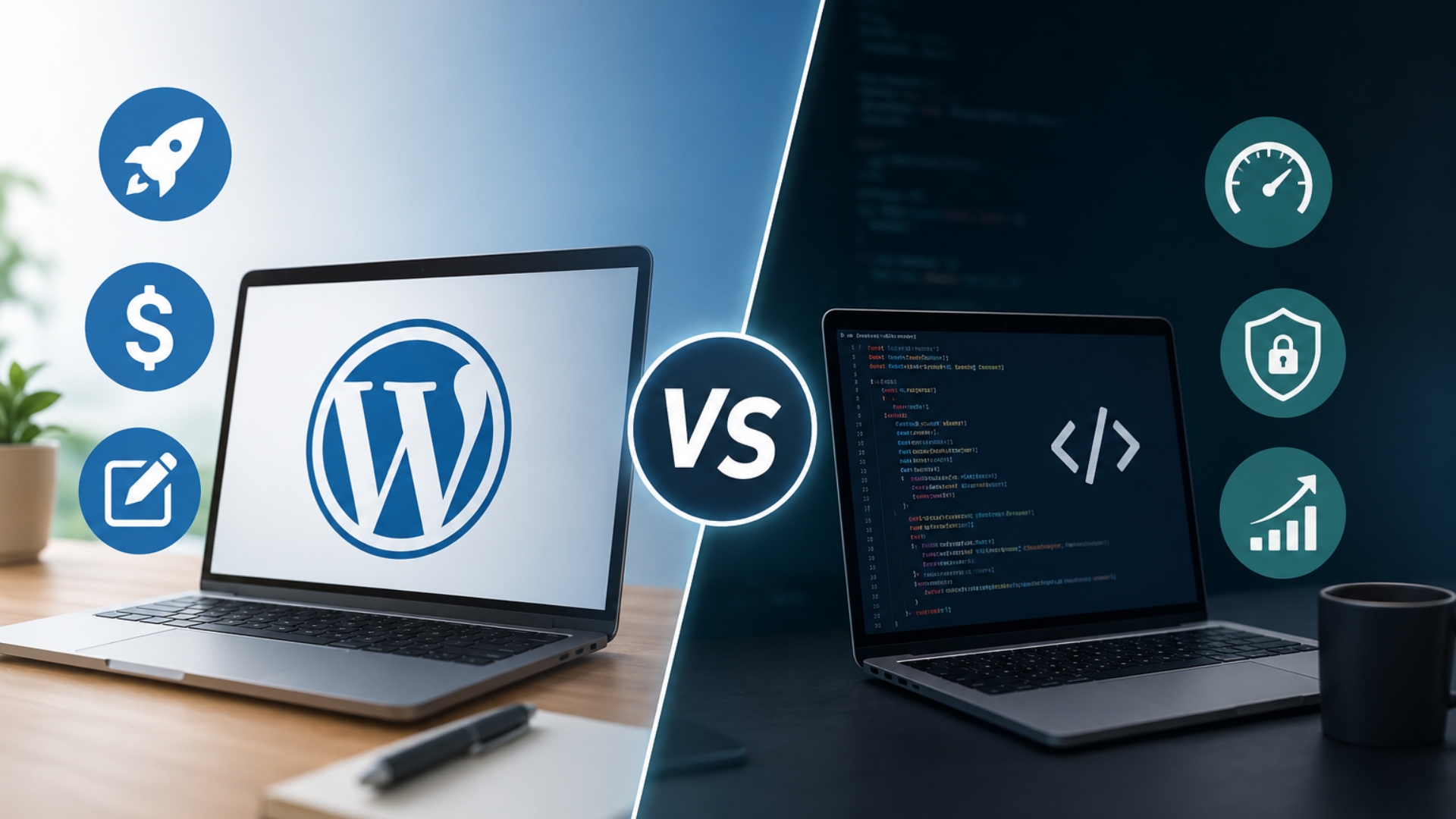
WordPress powers roughly 43% of all websites on the internet, making it the default for most businesses. Yet default does not always mean best. The WordPress vs. custom website debate comes down to cost, speed, security, and scale. WordPress launches fast and costs less upfront. Custom development delivers performance and control that plugins cannot match. The right choice depends on your stage, budget, and growth goals. Picking wrong often means overspending or rebuilding within a year. This guide compares both options across the factors that matter most. Use it to choose the right foundation for your business.
Key Takeaways
- WordPress suits content-focused sites needing fast, affordable launches.
- Custom websites win on performance, security, and unique functionality.
- WordPress launches in weeks; custom builds take three to six months.
- Custom sites usually pay back within two to three years.
7 Factors in the WordPress vs. Custom Website Decision for Your Business
1. Upfront Cost and Budget
Budget is the first deciding factor. WordPress wins on upfront cost for most businesses. A professional WordPress build costs $5,000 to $20,000, depending on scope. Custom development starts higher, often $25,000 or more. The gap reflects build time and engineering depth. In practice, WordPress fits limited budgets and standard needs. Custom suits businesses ready to invest in a purpose-built foundation. Match the spend to your current business stage.
2. Time to Launch
Speed to market often decides the choice. WordPress sites launch in two to six weeks because the foundation already exists. You configure rather than build from scratch. Custom development takes three to six months for quality work. As a result, WordPress wins when you need to launch fast. Custom requires patience and a longer runway. Choose WordPress if your timeline is tight and your needs are standard.
3. Performance and Page Speed
Speed directly shapes revenue and rankings. The average WordPress site loads in around 4.5 seconds once themes and plugins stack up. A custom site using modern frameworks loads under 1.5 seconds. HubSpot data shows conversions drop 4.42% per second of delay. Here is the key: plugin bloat creates speed problems, and WordPress then needs more plugins to fix. Custom code avoids that house of cards entirely.
4. Security and Risk
Security exposure differs sharply between the two. WordPress is the most targeted CMS worldwide. Roughly 30,000 WordPress sites are hacked every single day. Most breaches come through outdated plugins and unpatched files. Custom sites have a far smaller attack surface. They contain only code written for your application. That said, WordPress benefits from active community patching. Custom wins when you handle sensitive data or compliance requirements.
5. Scalability and Growth
Scalability depends on your traffic ceiling. WordPress scales well for small to medium businesses. Major publications and stores run on it successfully. However, custom code scales however you architect it. With massive traffic, many teams move to custom builds. For example, application-heavy platforms often outgrow CMS limits. Worth noting: most real-world businesses never hit WordPress’s ceiling. Choose custom only when extreme scale or complex logic is certain.
6. Ease of Content Management
Daily editing favours one option clearly. WordPress lets non-technical staff publish content easily. Its dashboard handles blogs, pages, and media without code. Custom sites need a built-in CMS or headless setup like Strapi. In practice, WordPress is ideal if your team updates content often. Custom requires developer involvement or a configured admin layer. Pick WordPress when in-house teams manage frequent updates themselves.
7. Long-Term Maintenance and Cost
Recurring cost reveals the true picture. WordPress carries ongoing plugin, theme, and hosting fees. Maintenance can run $300 to $600 monthly in developer time. Custom sites skip plugin subscriptions but need developer retainers. For high-traffic or app-heavy sites, custom is often cheaper over three years. To put it simply: factor in the total cost of ownership, not just the build. Custom usually pays back within two to three years.
The Bottom Line
The WordPress vs. custom website choice is a business decision, not just a technical one. WordPress wins for content-focused sites, tight budgets, fast launches, and in-house content teams. Custom development wins on performance, security, scalability, and unique functionality. For around 90% of small businesses, WordPress is the pragmatic choice. Custom pays off when performance impacts revenue or plugins cannot deliver your needs. The smartest decision matches the platform to your stage and goals. TheLikharis helps businesses choose and build the right foundation with confidence. Explore our professional web design services for tailored guidance. Map your priorities first, then request a project estimate today.

Frequently Asked Questions
Is WordPress or a custom website better for a small business?
WordPress suits about 90% of small businesses. It offers fast launches, lower upfront cost, and easy content management. Choose custom only when you need unique functionality, top performance, or extreme scalability.
How much does a custom website cost compared to WordPress?
A professional WordPress build costs $5,000 to $20,000. Custom development typically starts at $25,000 and rises with complexity. However, custom sites often cost less over three years for high-traffic projects.
Which is more secure, WordPress or a custom website?
Custom websites have a smaller attack surface since they run only purpose-built code. WordPress faces roughly 30,000 hacks daily, mostly via outdated plugins. Active community patching does help WordPress stay current.
Is a custom website faster than WordPress?
Usually yes. Custom sites using modern frameworks load under 1.5 seconds. The average plugin-heavy WordPress site loads around 4.5 seconds. Speed directly affects conversions, bounce rates, and Google rankings.
How long does it take to build each type of website?
WordPress sites launch in two to six weeks because the foundation exists. Custom development takes three to six months. Your timeline often decides the choice when needs are standard and urgent.
When should I choose custom development over WordPress?
Choose custom when you need unique functionality that plugins cannot provide, performance at a massive scale, a smaller security surface, or full architectural control. A budget above $25,000 and a development team also help.