
The global digital marketing market is projected to reach $807 billion by 2026. Yet most small businesses still rely on outdated playbooks. Smart digital marketing strategies for small businesses demand a multi-channel approach. Search, social, email, video, and AI all compete for the same budget. Picking the right mix decides whether you scale or stagnate. Modern SMBs face rising ad costs, shrinking attention spans, and AI-driven SERP changes. However, the data shows clear winners across every single channel. This guide breaks down ten proven strategies backed by recent industry benchmarks. Each tactic ties directly to measurable lead and revenue outcomes.
Key Takeaways
- SEO and local search still drive the highest organic ROI for SMBs.
- Short-form video and email marketing deliver the strongest conversion outcomes.
- AI tools cut content production costs while improving personalization at scale.
- Mobile optimization and online reviews shape every modern buyer journey.
10 Proven Digital Marketing Strategies for Small Businesses That Drive Growth
1. Build a Search Engine Optimization Foundation
Search engine optimization remains the highest-ROI channel for small businesses. Organic search drives 53% of all website traffic. Focus on technical SEO, on-page optimization, and topical clusters. Target long-tail keywords with low difficulty scores in tools like Ahrefs or Semrush. Build E-E-A-T signals through expert authorship and citations. Track rankings, organic sessions, and conversion rates monthly. SEO compounds over time. It outperforms paid channels for sustainable growth.
2. Dominate Local Search and Google Business Profile
Local SEO captures buyers ready to convert today. 80% of US consumers search online for local businesses weekly. Optimize your Google Business Profile with categories, photos, and weekly posts. Collect reviews through email and SMS prompts. Build citations on Yelp, BBB, and industry directories. Map pack rankings depend on relevance, distance, and prominence. Local searchers convert 3x faster than general traffic. Claim every neighborhood-based query in your service area.
3. Launch a High-ROI Email Marketing Program
Email delivers the highest ROI of any digital channel. Businesses earn an average return of $36 for every $1 spent on email. Segment your list by behavior, purchase history, and lifecycle stage. Use double opt-in to maintain deliverability and reduce spam complaints. Trigger automated sequences for cart abandonment, onboarding, and re-engagement. Personalization lifts open rates by 17% on average. Test subject lines, CTAs, and send times monthly.
4. Invest in Short-Form Video Content
Short-form video drives the highest engagement across every social platform. 21% of marketers say short-form video delivers the highest ROI. Focus on TikTok, Instagram Reels, and YouTube Shorts. Keep clips between 15 and 60 seconds for maximum retention. Lead with a hook in the first 3 seconds. Use captions, on-screen text, and trending audio for reach. Repurpose long-form content into bite-sized clips.
5. Build a Content Marketing Engine
Content marketing builds organic authority and trust at scale. Small businesses are 23% more likely to see ROI from blog posts. Plan topical clusters around buyer intent, not just keywords. Mix pillar pages, blog posts, case studies, and downloadable assets. Aim for 1,200 to 1,800 words per pillar piece. Publish consistently using a documented editorial calendar. Distribute content via email, social, and SEO together. Quality beats publishing volume for SMBs.
6. Run Targeted Social Media Advertising Campaigns
Social ads deliver fast reach when organic posts plateau. 60% of small businesses plan to raise marketing budgets in 2026. Allocate spend across Meta, LinkedIn, and TikTok based on audience fit. Use lookalike audiences built from your customer data. Test creative variants weekly with at least 5 ad sets per campaign. Track CPA, ROAS, and CTR side by side. Niche audiences convert better and burn less spend on small budgets.
7. Use PPC for Predictable Lead Flow
Pay-per-click ads buy you instant visibility on commercial keywords. US digital ad spend is projected to exceed $383 billion by 2027. Start with high-intent search terms before expanding to display. Use match types strategically to control wasted spend. Set up conversion tracking in Google Ads and GA4. Optimize your quality score to lower your cost-per-click. SMBs should aim for a 3:1 ROAS minimum.
8. Integrate AI Tools Across Your Marketing Stack
AI cuts production time and boosts personalization for resource-strapped SMBs. 75% of marketers now use AI tools daily in their workflows. Apply AI to keyword research, content drafts, ad copy, and segmentation. Use ChatGPT, Claude, or Jasper for first-draft content production. Always edit AI output for accuracy and brand voice. Automate lead scoring and email triggers via HubSpot or Mailchimp. Pair AI with human judgment for the best results.
9. Optimize for Mobile-First Experiences
Mobile traffic now exceeds 60% of all web sessions globally. 80% of consumers research a company online before purchasing. Most of that research happens on smartphones. Compress images, defer scripts, and lazy-load assets for faster speeds. Aim for a Core Web Vitals score in the green zone. Test forms, CTAs, and checkout flows on real devices. Page load delays of one second cost up to 7% in conversions.
10. Activate Online Reviews and User-Generated Content
Reviews and UGC build trust faster than any branded campaign. 92% of consumers trust user-generated content more than traditional ads. Ask happy customers for reviews on Google, Yelp, and industry sites. Respond to every review within 24 hours, positive or negative. Repurpose UGC across landing pages, ads, and product pages. Run referral programs to amplify word-of-mouth. Trust signals lift conversion rates by 15% on average.
The Bottom Line
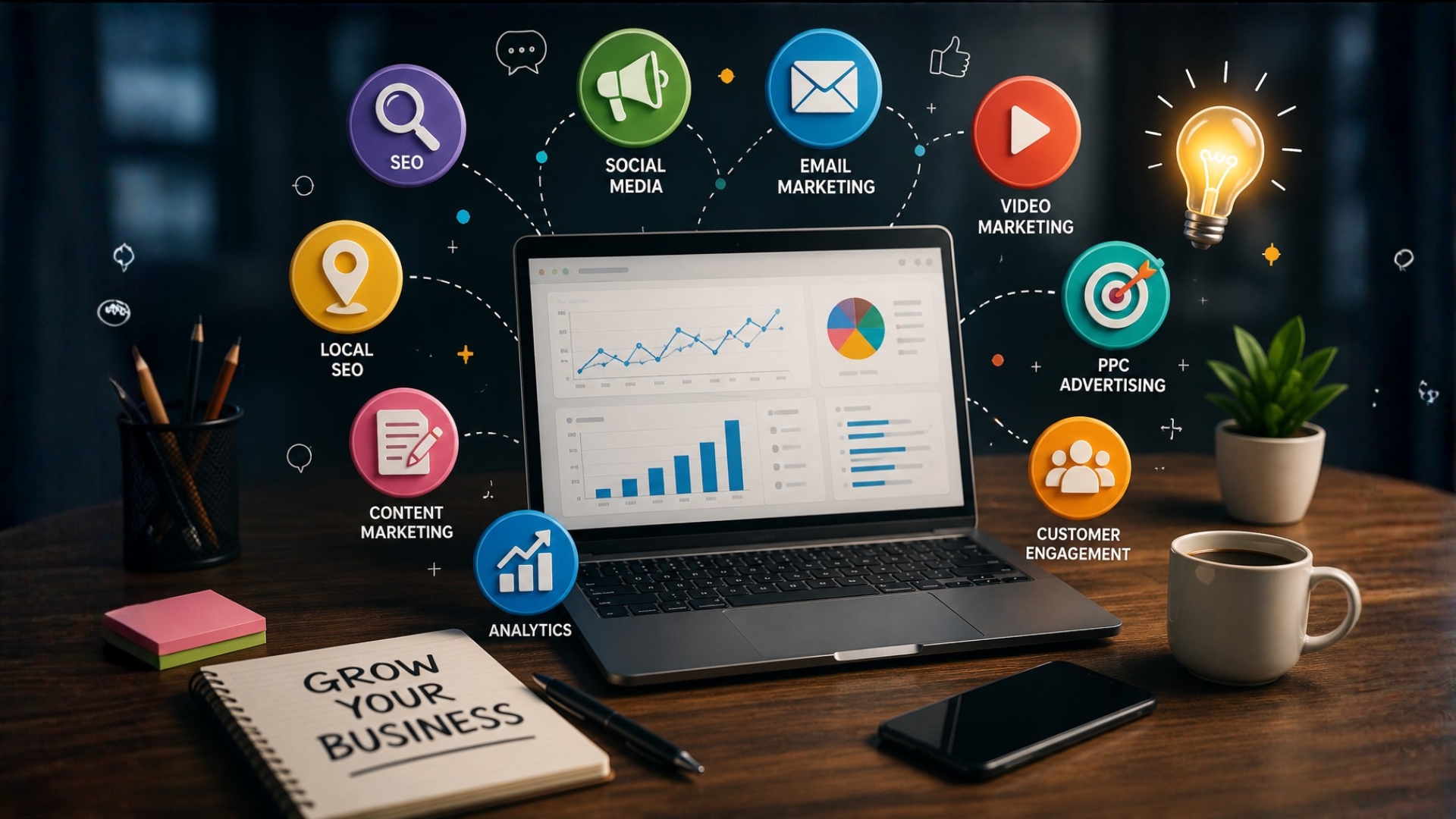
Digital marketing strategies for small businesses succeed when they connect data, channels, and intent. SEO, local search, email, video, content, and AI now work together as one system. No single tactic wins on its own in 2026. Budget allocation matters more than channel choice. Measure ROI by revenue impact, not vanity metrics. At TheLikharis, our team builds custom playbooks across all ten strategies. From keyword research to AI-driven content production, we cover the full stack. See our digital marketing and SEO services to learn how we drive measurable growth. Audit your current marketing mix this week and align every channel with revenue goals.

Frequently Asked Questions
What are the most effective digital marketing strategies for small businesses in 2026?
The most effective strategies include SEO, local search, and email marketing. Short-form video and AI-driven content production also rank high. Social ads and online reviews also drive measurable growth. Mix depends on your industry and customer intent.
How much should a small business spend on digital marketing?
Most small businesses allocate 7% to 12% of revenue to digital marketing. Service brands spend more on local SEO and Google Ads. E-commerce brands invest heavily in social ads and email. Adjust based on customer acquisition cost and ROAS targets.
Which digital marketing channel offers the best ROI for SMBs?
Email marketing offers the highest ROI for most small businesses. Industry data shows returns of $36 per $1 spent. SEO and content marketing rank second in terms of long-term ROI. Short-form video leads engagement metrics across social platforms.
How long does it take to see results from digital marketing?
SEO and content marketing usually take 6 to 12 months to show measurable results. PPC and social ads deliver leads within days. Email automation produces ROI within weeks of launch. Timelines depend on competition, budget, and execution quality.
Should small businesses use AI for digital marketing?
Yes. AI tools cut content production costs and improve personalization at scale. Use AI for keyword research, ad copy, email drafts, and lead scoring. Always pair AI output with human review. Brand voice, accuracy, and ethics still need human judgment.
Is social media marketing still worth it for small businesses?
Yes. Social media drives brand awareness, customer service, and direct response sales. Focus on one or two platforms where your audience spends time. Short-form video and reviews perform best. Avoid spreading thin across every network at once.